Girolamo Antonucci
The Power of the DogGirolamo Antonucci, the papal nuncio in Mexico and a politician from the Church’s arch-conservative wing, works to restore the Catholic Church’s formal standing in a country where it has long operated under an uneasy accommodation with the government. His mission joins anti-Communist concern to institutional ambition: he wants to keep Mexican Catholics within the Church, but also to recover public recognition and influence. His dispute with Archbishop Parada exposes the tension between pursuing those aims through political leverage and responding directly to urgent need.
Mission and Political Outlook
Eight years before the events described, Antonucci was sent from Rome to bring Mexico formally back into the Church’s fold. The assignment reflected a long-running Vatican objective, not merely a response to the immediate crisis. Antonucci’s arch-conservative outlook informs how he frames that objective: he has warned Parada and other bishops against losing Mexico’s faithful to what he regards as godless Communism. For him, the Church’s position in Mexico is therefore both a question of institutional status and a contest over political and religious allegiance.
The broader narrative places this concern within a region where anti-Communist claims are also used to justify covert action. U.S. officials elsewhere describe Nicaragua as a strategic threat and present support for armed opponents as necessary. Antonucci is not shown directing those operations; his stated concern is the Church’s standing and the allegiance of the faithful. The parallel nevertheless gives his warning a larger political context: fears about Communism are not confined to Church affairs, even when the consequences of acting on those fears differ sharply.
The Church and the Mexican State
The history behind Antonucci’s mission reaches back to the nineteenth century. The Ley Lerdo of 1856 seized Church-owned haciendas and other lands and sold them. Mexico’s revolutionary constitution of 1857 further stripped the Church of power; the Vatican responded by excommunicating Mexicans who took the constitutional oath. In the account of this history, the conflict produced more than a century without restored formal relations.
By Antonucci’s time, the estrangement had softened into a grudging accommodation. The Institutional Revolutionary Party had governed Mexico in a one-party, pseudo-democratic system since 1917. Even its most strongly anti-clerical members did not seek to abolish the Church altogether. The state still imposed petty restrictions, including a ban on clerical garb, but the government and Vatican had learned to coexist without formal diplomatic relations. Antonucci’s assignment seeks to move beyond that practical truce and secure recognition, making his project more ambitious than simply protecting the Church’s existing room to operate.
Negotiation During the Crisis
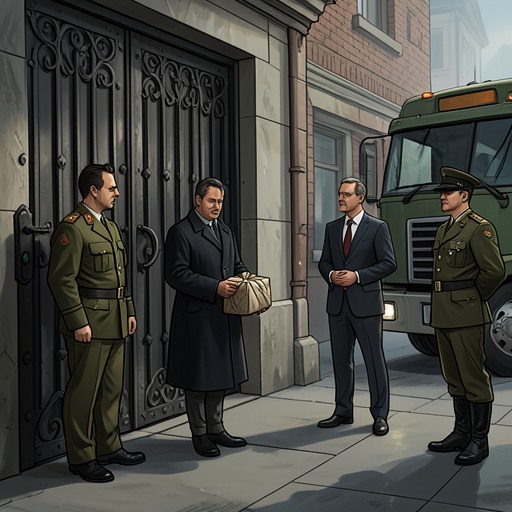
When streets are blocked and urgent work remains, Parada is at the papal nuncio’s residence directing activity from Antonucci’s office. The scene places the two churchmen together in the immediate demands of the crisis, but their approaches diverge when political negotiation begins. Parada offers financial and material aid on an informal basis in exchange for permission for clergy to wear the cross and for Church aid to be clearly identified as such. He also asks the government to guarantee that the next administration will begin good-faith negotiations on formal relations within thirty days of taking office.
The timetable matters: Parada acknowledges that the next administration will not take office for almost three years. Even so, he presses for a commitment now, and the minister agrees. The bargain makes visible the compromise at the center of the episode. Aid can be delivered without waiting for formal relations to be restored, while the Church gains specific public concessions and a promise of future negotiations. Parada treats the arrangement as a way to get needed assistance moving; Antonucci sees his own authority and negotiating position being bypassed.
After the minister leaves, Antonucci rebukes Parada for superseding him. He believes he had the minister on the run and objects to Parada negotiating over him. Parada challenges the purpose of that approach, asking whether the Church’s role is to keep needy people under pressure. The disagreement is not simply over procedure: it reveals two competing priorities within the same institution. Antonucci wants to preserve leverage for a larger diplomatic objective; Parada insists that leverage should not take precedence over people who need help. The deal is reached, but it also leaves their conflict unmistakable.
Disciplinary Authority and Significance
Antonucci’s authority over Parada appears again when he summons the archbishop to Mexico City, Mexico, to explain what he calls grave pastoral and doctrinal errors in Chiapas. The discussion turns to liberation theology. Parada dismisses the topic rather than accepting Antonucci’s framing of it, underscoring their disagreement about how religious work in Mexico should be judged and governed. The episode establishes that Antonucci’s role is not only diplomatic: he also acts as an ecclesiastical authority prepared to question a bishop’s pastoral and doctrinal conduct.
Across these encounters, Antonucci represents a Church seeking a more secure public position through negotiation, discipline, and resistance to Communist influence. His aims are clear, but the narrative does not portray him as the sole voice of the Church: Parada’s actions demonstrate that institutional service can also mean bypassing hierarchy when urgent assistance is at stake. Antonucci’s confrontation with him therefore gives the larger Church-state story an internal fault line. Formal recognition matters to Antonucci; the means used to pursue it, and the people those means may leave waiting, matter just as much to Parada.